

The Council of Ministers approved this Tuesday a royal decree amending the Bullfighting Regulations to definitively close any legal loophole that would allow the authorization of comic-bullfighting shows that degrade people with disabilities. The new paragraph 4 of Article 90 of the Regulations is unequivocal: "Comic-bullfighting shows shall respect human dignity, and may not harm the rights of individuals or subject them to public mockery or denigration, particularly of social minorities, such as people with disabilities." The competent governmental authority is expressly prohibited from authorizing any event that infringes this mandate.
For those who had been demanding this measure for years, the news has the bittersweet taste of delayed justice. "We documented these shows for years precisely so that no one could look the other way. What happened in those bullrings was neither culture nor entertainment: it was the institutionalization of mockery towards people with disabilities, furthermore framed in a context of cruelty towards animals," says Aïda Gascón, director of AnimaNaturalis in Spain.
Years of Denunciation Without Response
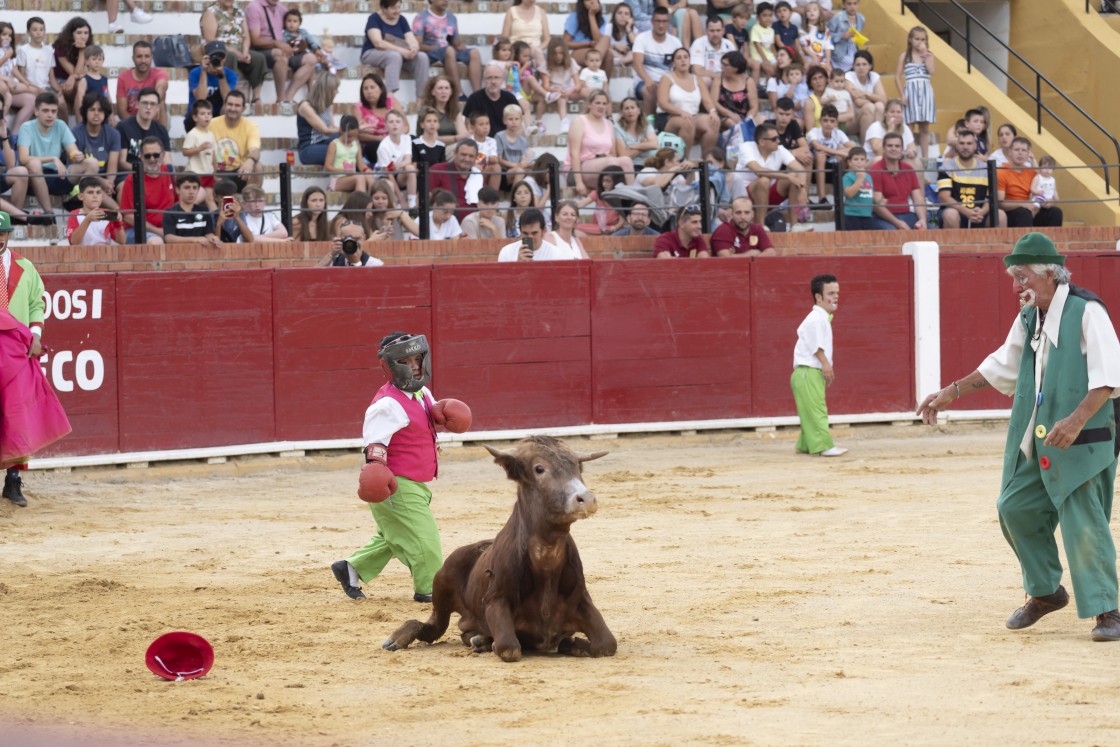
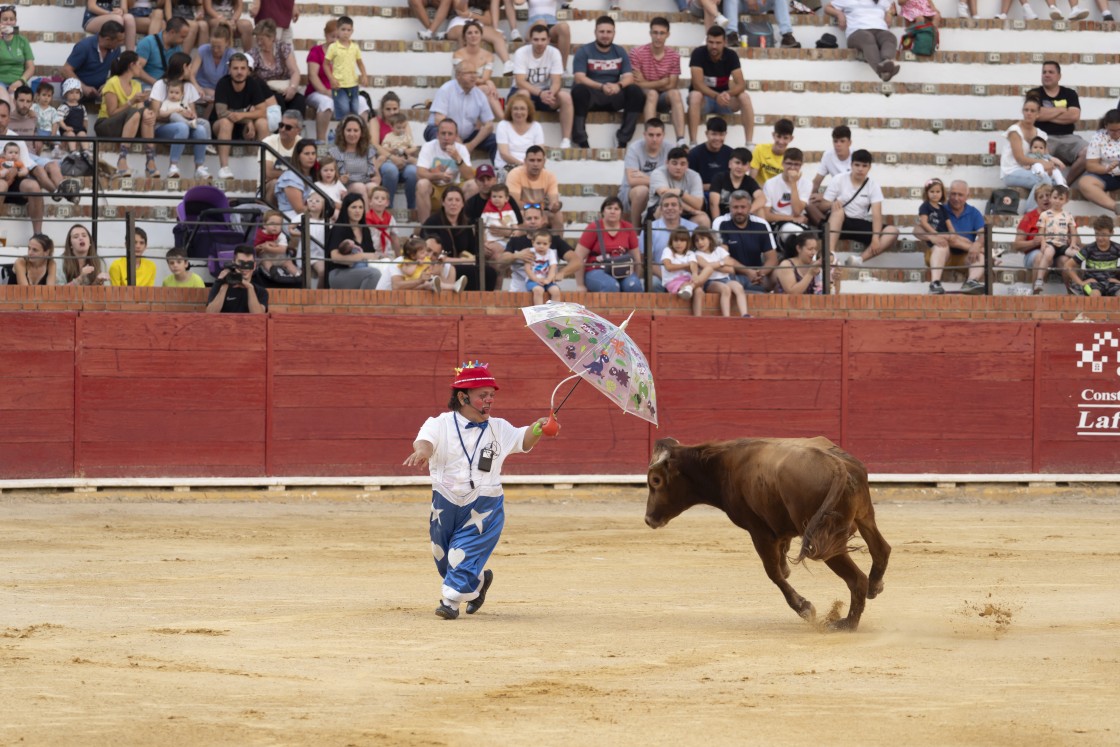
It was Tuesday, July 4, 2023. In Teruel, under the summer sun and the noise of the Fiestas del Ángel, a show that had been repeated with impunity for years was taking place: the so-called "Popeye torero and the sailor dwarves." Inside the bullring, people with achondroplasia — a condition that causes dwarfism — performed before a laughing audience. Outside, with cameras and notebooks, were the teams from AnimaNaturalis and CAS International, documenting in detail what was happening. It wasn't the first time. It wouldn't be the last.
We had been denouncing for years the systematic holding of this type of comic bullfighting shows in various bullrings across Spain, despite the fact that the General Disability Law — Royal Legislative Decree 1/2013 — already implicitly prohibited them. The law forbade activities that promoted mockery or humiliation towards people with disabilities. However, promoters found shelter in lax interpretations and the absence of an explicit prohibition in the Bullfighting Regulations.
This ambiguity had real consequences. In 2023, the Junta de Andalucía denied authorization for one of these shows in Cortes de la Frontera — in a historic first for the region — explicitly citing the disability law. The promoter appealed. And the judge of the Administrative Litigation Court number 5 of Málaga ruled in favor of the show, arguing that there was no "objective data" to conclude that the purpose was "the mockery of these people or their disability." A judicial blow that frustrated the ban, but not the fight.
In July 2024, both organizations reported the same show again, this time with an aggravating factor: the Ombudsman, Ángel Gabilondo, had already urged the Department of Presidency, Interior and Culture of the Government of Aragon to suspend the event, arguing that it contravened the regulations on the rights of persons with disabilities. The department ignored the recommendation. The show went on.
"The powerlessness of seeing the law violated before your eyes, with the implicit endorsement of the institutions, is one of the hardest experiences of activism. That's why we document: so that reality speaks louder than the arguments of those who profit from these practices," notes Gascón.
When Tradition Shields Cruelty
Comic-bullfighting shows involving people with disabilities do not exist in a vacuum. They are another piece in a machinery of public subsidies that AnimaNaturalis has been analyzing for decades. According to data from the Ministry of Culture, only 8% of the Spanish population attended any bullfighting event in the 2018-2019 period, and 92% of the country did not attend any bullfighting festival that year. Despite this, the industry continues to receive public money and legal coverage.
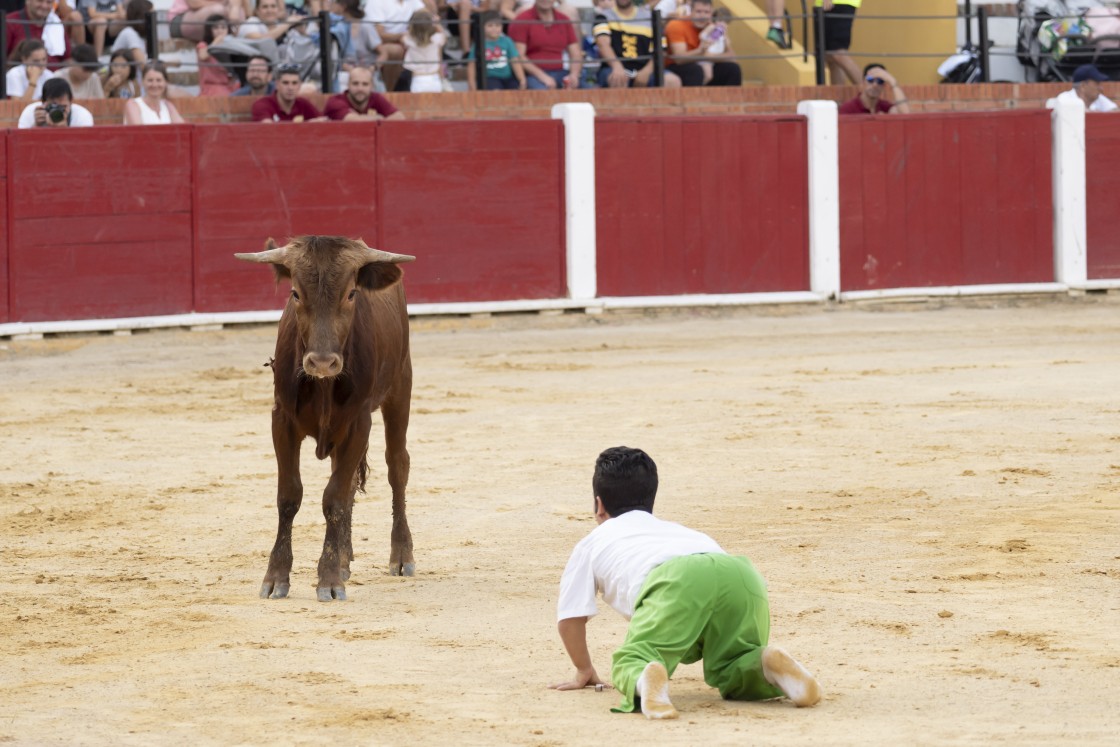
In this context, shows with people with dwarfism represented one of the most visible forms of the double violation that characterizes certain bullfighting spectacles: that of the animals used in them and that of the human beings instrumentalized for the entertainment of others. In 2023, AnimaNaturalis documented how, at the end of one of these shows in Teruel, heifer calves under eighteen months old were released so that minors under sixteen could actively participate in the spectacle. Cruelty towards animals and normalization of violence, all in the same bullring.
The regulatory reform approved this Tuesday also coincides with a moment of growing international pressure. In January 2026, the UN Committee on the Rights of the Child asked Spain for explanations for allowing minors to attend bullfighting events. And in October 2025, the Congress of Deputies rejected, with the decisive abstention of the PSOE, a Popular Legislative Initiative supported by more than 600,000 signatures that sought to remove national cultural protection from bullfights.
"Bullfighting as a whole continues to be a model of animal exploitation protected by the State. We celebrate that these specific gaps are being closed, but we cannot lose sight of the full picture: every year, thousands of individuals are killed in the bullrings. Today's reform is a step, not the destination," states Gascón.
The royal decree approved this Tuesday introduces specific mechanisms to ensure the prohibition is not just empty words. The reform of the General Disability Law, currently being processed in parliament, plans to classify shows that denigrate people with disabilities as very serious infractions, with fines between 600,000 euros and one million euros. These are sanctions high enough to deter promoters who, until now, found the economic profitability of the show to be a greater incentive than the legal risk.
In parallel, the Ministry of Social Rights, Consumer Affairs and the 2030 Agenda, led by Pablo Bustinduy, recalls that since 2022, the program Footprints with Dignity, developed together with the ONCE Foundation, offers social support and job training to people with disabilities who had worked in these shows. The goal is to facilitate their transition to jobs that do not require exposing their bodies to public mockery. To date, the program has assisted those who, according to the Ministry itself, "have been forced to work in these bullfighting shows and in other types of degrading shows that publicly ridicule their bodies."
The royal decree also includes the creation of the UTAC (Technical Support and Coordination Unit), a body specialized in supervising compliance with the European Accessibility Directive (EU 2019/882), positioning Spain among the countries with the highest regulatory rank in terms of accessibility and inclusion.
For AnimaNaturalis, these measures are welcome but insufficient if not accompanied by a deeper review of the bullfighting model as a whole. The organization has spent years documenting that bullfighting shows, in all their variants, involve the confinement, instrumentalization, and killing of animals who are sentient beings, capable of experiencing pain, fear, and suffering. The prohibition of comic-bullfighting shows is consistent with an ethics of rights, but that same ethics, applied consistently, should also extend to the individual animals that die each year in Spanish bullrings.
The Citizen Pressure That Made This Change Possible
The royal decree approved this Tuesday would not have been possible without years of fieldwork, public denunciation, and citizen mobilization. AnimaNaturalis and CAS International went to the bullrings, filmed what happened, sent the images to the media, mobilized thousands of people to write letters to institutions, and kept the pressure alive when the courts ruled against them. More than 1,000 protest emails sent to the Department of the Government of Aragon in 2024 are an example of how sustained collective action can turn the tide of institutions.
Now, the work continues. Because while the most visibly degrading shows for human beings are banned, the killing of thousands of animals in bullrings remains legal, subsidized, and culturally protected. Because the UN Committee on the Rights of the Child has been asking Spain for years to protect minors from exposure to bullfighting violence, and Spain has not acted. Because 92% of the Spanish citizenry does not attend bullfighting events, and yet their money continues to finance them.
"Every partial victory reminds us that change is possible when citizens get involved. But it also reminds us of the distance left to travel. We need more people to join this cause, not only to celebrate what is achieved, but to demand what is missing," concludes Gascón.
If you believe that no being, human or non-human, should be instrumentalized for the entertainment of others, this is your moment to act. Become a supporter of AnimaNaturalis, support their on-the-ground investigation and denunciation work, and share this article so that the reality of bullfighting shows reaches those who still do not know it. The next bullring to be emptied, the next law to be passed, could have your name behind it.


